
Watching a football match for the first time and constantly hearing commentators mention terms like offside, hat-trick, and high press without knowing what they mean? Football may seem complicated at first, but it is actually easier to understand once you learn a few common football terms.
Below are 20 essential football terms that beginners are likely to encounter, helping you understand matches, rules, player positions, and tactics more quickly.
20 Essential Football Terms for Beginners
1. Offside
Offside is one of the football rules that beginners often find the most confusing. In simple terms, a player may be in an offside position if, at the moment a teammate plays the ball to them, they are closer to the opponent’s goal line than both the ball and the second-last opponent.
However, simply standing in an offside position is not automatically an offense. The referee will penalize the player only if they become actively involved in play, interfere with an opponent, or gain an advantage from that position.
2. Penalty Kick
A penalty kick may be awarded when a defending player commits an offense inside their own penalty area that would normally result in a direct free kick, such as pushing, pulling, kicking an opponent, or certain handball offenses.
The penalty is taken from the penalty spot, approximately 11 meters from the goal, with the shooter facing the goalkeeper directly. Because of this, a penalty is usually considered one of the best goalscoring opportunities in football.
3. Free Kick
A free kick is awarded after certain fouls or offenses, allowing the opposing team to restart play from a designated position.
There are 2 main types of free kicks: direct and indirect. A direct free kick can be scored directly into the opponent’s goal, while an indirect free kick must touch another player before a goal can be awarded.
4. Corner Kick
A corner kick is awarded when the defending team is the last to touch the ball before it completely crosses their own goal line without a goal being scored.
Corners are important set-piece opportunities. Teams can use crosses, headers, short-corner routines, or carefully planned movements to create goalscoring chances.
5. Throw-in
A throw-in restarts play when the entire ball crosses either touchline.
The throw-in is awarded to the opposing team of the player who last touched the ball. The player taking the throw must use both hands and deliver the ball from behind and over their head while following the required throw-in technique.
6. Hat-trick
A hat-trick occurs when one player scores three goals in the same match.
The goals do not have to be scored consecutively, nor do they need to be scored in different ways. Completing a hat-trick usually indicates an outstanding attacking performance from the player.
7. Own Goal
An own goal occurs when a player accidentally sends the ball into their own team’s goal.
For example, a defender may attempt to clear the ball but accidentally redirect it into their own net. An own goal is commonly abbreviated as OG in football statistics and match reports.
8. Assist
An assist is generally awarded to the player who provides the final key pass before a teammate scores.
For example, if a winger delivers a cross and a striker heads the ball into the goal, the winger will usually receive an assist. Assist statistics are often used to evaluate a player’s creativity, passing quality, and ability to create goalscoring opportunities.
9. Clean Sheet
A clean sheet means that a team completes an entire match without conceding a goal.
For example, if a team wins 2-0, the goalkeeper and defensive unit have recorded a clean sheet. Clean sheets are commonly used to evaluate goalkeepers and defensive systems.
10. Added Time
Each half of a standard football match normally lasts 45 minutes. However, substitutions, injuries, VAR reviews, time-wasting, and other interruptions can reduce actual playing time.
The referee therefore adds additional minutes at the end of each half. This is known as added time, stoppage time, or injury time.
11. VAR (Video Assistant Referee)
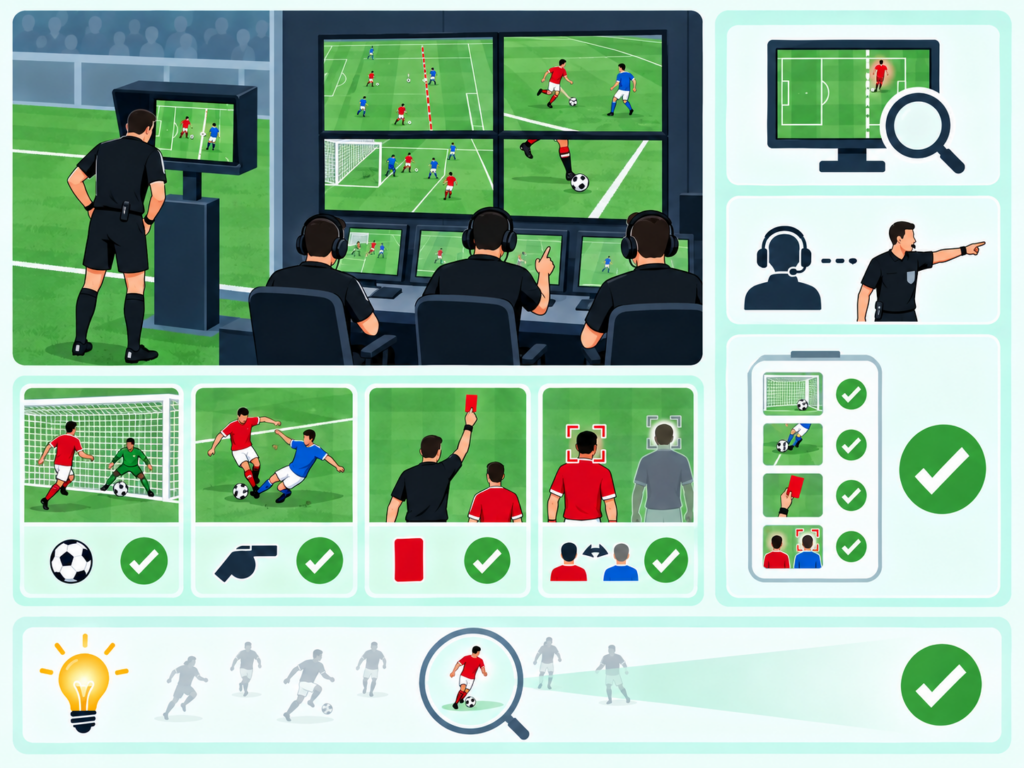
VAR stands for Video Assistant Referee. It is a system designed to help match officials review important decisions that could significantly affect the outcome of a match.
VAR is mainly used for goals, penalty decisions, direct red cards, and mistaken identity. It is not intended to review every ordinary foul or minor incident during a match.
12. Forward
A forward is an attacking player who usually operates closer to the opponent’s goal.
Their main responsibilities include creating shooting opportunities and scoring goals. Common types of forwards include center-forwards, second strikers, and wingers. Each role may require different combinations of movement, pace, physical strength, positioning, and finishing ability.
13. Midfielder
Midfielders connect a team’s defense and attack and often play a central role in controlling the match.
Some midfielders focus mainly on defending and winning possession, while others focus on passing, creating chances, and supporting attacks. Common midfield roles include defensive midfielder, central midfielder, and attacking midfielder.
14. Defender
A defender’s main responsibility is to protect their own goal and prevent opposing players from creating scoring opportunities.
Common defensive positions include center-back, left-back, and right-back. In modern football, full-backs are often expected to contribute to attacks as well, providing crosses, overlapping runs, and sometimes even goals or assists.
15. Goalkeeper
The goalkeeper is the only player who is normally allowed to handle the ball with their hands inside their own penalty area.
Besides making saves, modern goalkeepers are also expected to distribute the ball, pass accurately, communicate with defenders, and sometimes help build attacks from the back. Their role has therefore become much more than simply stopping shots.
16. Possession
Possession refers to the percentage of time each team controls the ball during a match.
For example, if one team has 60% possession, it means they controlled the ball for roughly 60% of the measured possession time. However, higher possession does not automatically mean a team will win, as attacking efficiency and chance quality matter just as much.
17. Shot on Target
A shot on target is a shot that would enter the goal if it were not stopped by the goalkeeper or another legitimate defensive intervention.
Goals also count as shots on target. This statistic helps football fans understand how many genuinely threatening shooting opportunities a team has created.
18. Counter Attack
A counter-attack happens when a team regains possession and quickly moves forward before the opposition has enough time to reorganize its defense.
Fast forwards and wingers are particularly effective in counter-attacking systems because they can exploit open spaces behind defenders and create dangerous one-on-one or fast-break situations.
19. High Press
A high press is a tactical approach where a team applies pressure close to the opponent’s goal rather than waiting for them to advance further up the pitch.
The objective is to force defenders or the goalkeeper into passing mistakes. If the team regains possession high up the pitch, it can immediately create a scoring opportunity from a dangerous position.
20. Counter-attacking Football
Counter-attacking football is a tactical style in which a team first maintains a compact defensive shape and allows the opposition to have more of the ball.
Once possession is regained, the team quickly attacks the spaces left behind by the opposition. This approach can be particularly effective for teams with fast forwards or wingers who are capable of exploiting open space.
Understanding Football Is Easier Than You Think
If you are new to football, you do not need to memorize every complicated rule or tactical concept immediately.
Start with common football terms such as offside, penalty kick, free kick, VAR, possession, and hat-trick. Understanding these basics will already help you follow most of what happens during a football match.
Once you become familiar with these concepts, you can move on to topics such as football formations, player positions, xG (Expected Goals), high pressing, and different football tactics.
The more you understand, the more you will realize that watching the Premier League, Champions League, World Cup, or other football competitions is not only about following the score. You will start to understand how teams play, why they make certain decisions, and what is actually happening on the pitch.